 Hardware Retailing The Industry's Source for Insights and Information



While not unique to the independent channel, wage challenges can cause extra stress on small business owners already juggling tight margins.
According to the U.S. Bureau of Labor Statistics, in February 2026, wages rose more than expected, increasing 0.4% for the month and 3.8% from a year ago.
When outside factors like rising wage costs, increased minimum wage, government regulations and evolving employee expectations directly impact your business, finding a balance between retaining good employees with more-than-fair wages and not bankrupting the business can be challenging.
As you develop strategies to address your own wage challenges, three retailers share how they are managing payroll roadblocks through training, thoughtful benefit packages and strong company cultures.
Counteracting With Cross-Training
 With four stores in different Ohio communities under its umbrella, Western Ohio True Value Hardware addresses wages and benefits on a store-by-store basis to best serve employees in those locations. The Troy, Ohio, store is located in a larger city, while the Minster, St. Henry and Wapakoneta, Ohio, stores serve smaller towns.
Human resources manager Rob Kuenning says employees at the Troy store are paid a slightly higher wage than the other locations because of Troy’s location near a major city and competition for jobs in that area.
Kuenning reviews and adjusts wages for hourly employees every year to account for any minimum wage increases that come through that year. For salaried employees, salary reviews take place two or three times a year.
“When I look at wages, I’m usually looking for those employees who I know are doing an excellent job and deserve the raise based on merit,” Kuenning says. “I also give raises every year, so I will base raises on work anniversaries, which I track through Paycor, my HR platform. Ultimately, raises come down to how much cash flow I have because even those small percentages add up when you have 110 employees.”
When higher wage costs lead to increased costs across the operation, Kuenning takes a deep dive into how each employee is paid, creating a “budget” that outlines the wages of every employee, from the general manager down to frontline associates.
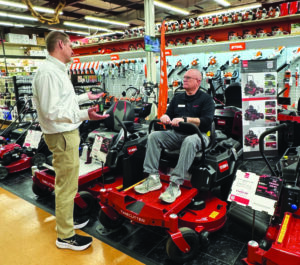 Looking at wages by employee line-by-line allows Kuenning to view wages in proportion to sales. He can look at his wages budget and see what sales need to be in each store to allow him to give the wage increases and bonuses he wants to give employees.
Kuenning also offsets higher wage costs by running leaner teams at the stores and reducing store hours during the slower winter months.
“Our goal is to be back to regular hours by mid-March each year,” he says. “Reducing hours during our lowest-selling months helps us adjust for increasing payroll costs.”
Cross-training at the Troy store has also been key to helping cover shifts with fewer employees. Kuenning says that previously, they would put employees on the floor whose focus was helping customers find the products they need and answer questions, while other employees handled the point-of-sale transactions and selling bigger ticket items.
“We’re working on training our employees to be able to work the store floor, who have that knowledge of core hardware and can answer questions, but who can also work the register and sell big ticket items,” Kuenning says.
Kuenning hired a designated trainer for all new employee POS training, who also serves as the welcoming face of the company for new employees.
“It’s extremely important for us to have someone patient and passionate in everything she does to be the welcoming face for new employees to see,” he says.
Beyond point-of-sale, the training shifts to department heads or store managers, depending on the category and generally lasts for two weeks.
“This seems like a lot, but we use our POS system to the greatest extent and want to make sure trainees are comfortable and fairly efficient before giving them their initials to be on their own,” Kuenning says.
Because balancing training time with day-to-day productivity demands is extremely challenging and Kuenning’s designated POS trainer now only focuses on training new employees, he has cross-trained other employees to pick up the other tasks she used to own.
“In order for my POS trainer to allocate 100% of her time training new employees, other individuals are needed to step up and help out,” Kuenning says. “If we didn’t cross-train like this, training would be even harder or slower to accomplish, or we would have to lower our standards and accept more mistakes or confusion due to lack of training. The latter is not an option for our operation, so we make sure others know how to help cover.”
While the company’s cross-training strategy has been effective, Kuenning says he has run into two major roadblocks.
First, some employees struggle to keep up with the fast training schedule, so Kuenning will backlog training and have other employees cover tasks while those employees continue to learn.
Second, because of the amount of training, employees can get overwhelmed if they get too backlogged with their own work while other employees are training. In these cases, Kuenning will have conversations with those individuals, reassuring them of the impact the training will actually have in the long run.
“I personally do all the hiring for the company in all stores and because of this, I am able to seek out individuals who I feel will fit the culture and be the type of individual we want someone to be and need in our operation,” Kuenning says. “I’m able to explain to my current staff members who are upset or feeling stressed on how important the training is and hopefully how much easier everyone’s life will feel once a trainee is fully contributing to the success of the company.”
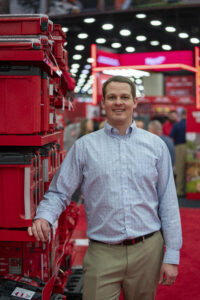 Regardless of any payroll increases and needing to shuffle hours and duties among employees, ultimately, Kuenning and the leadership team at Western Ohio True Value take care of their employees. Employees see and feel this intentionality, which improves retention and leads to employees wanting to put in the time needed each shift. The company also offers a comprehensive benefits package that includes health insurance, a 401(k) retirement plan, vacation hours and flexible scheduling.
“In the communities where we have stores, we compete against a lot of factories for employees, so that flexible scheduling is especially important, as most factories cannot offer that perk,” Kuenning says. “The retirement benefit we offer is also important to take care of our employees.”
The leadership team at Western Ohio True Value Hardware also strives to reinforce culture into every aspect of the company, including wages and benefits. Kuenning admits this can be challenging, so they use phrases with employees such as “What is best for the business?” or “Wouldn’t you want someone to help you out if you had to be off?”
“Our motto is ‘Providing the Greatest Customer Service Possible,’ and we understand that it’s the customers who are signing our paychecks, not the owners. We must work together as best as possible to achieve this goal,” Kuenning says. “As owners, my family and I truly appreciate each and every one of our employees and refer to them as our work family. Because we are family-oriented, we encourage a culture where employees help one another as they would help a brother or sister.”
Picking the Right People
Traditionally, leadership at Wood Shed Lumber & Hardware Supply had reviewed wages annually at the start of the new year. As the company has grown, that timing has added pressure on the company’s slower season, making increases harder to absorb all at once, says co-owner Sharona Eiserer.
 “We’re transitioning to reviewing wages based on employee hire anniversaries, which spreads the impact throughout the year but requires more detailed tracking and planning,” she says.
Wood Shed Lumber & Hardware Supply has six locations in Missouri, and Eiserer says wage strategies can vary from store to store because the larger or more competitive markets require higher wages to attract quality candidates. Ultimately, experience and product knowledge play a larger role than location alone when determining compensation for employees.
To address the increase in minimum wage in Missouri, Eiserer says the company has shifted its mindset and is doing more with less, investing more heavily in the company’s strongest people and being intentional about where every dollar goes.
“I’ve always believed in cross-training our employees, and that philosophy has become even more important,” she says. “We rely on tighter scheduling with key employees, and our teams are often managing call-ins and sick-day abuse while still maintaining service levels.”
When looking at wages through the lens of employee retention, Eiserer says wages are one of the easiest—and most frustrating—parts of retention.
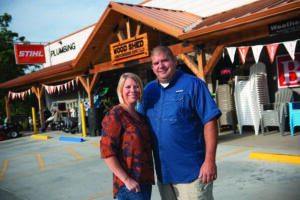 “Competitive pay matters, but you can’t deliver consistent customer service without reliable, committed people who can handle the daily demands of the business,” Eiserer says.
Along with competitive pay, the company offers health insurance, with the company covering 50% of the employee’s portion, and a simple IRA retirement plan.
“Between rising wages and benefit expenses, maintaining profitability is becoming more challenging for independent retailers,” Eiserer says. “That makes accountability, reliability and teamwork more critical than ever. This isn’t just about a paycheck—it’s about building a reliable team to navigate this journey together.”
Hiring for culture is also a key way that Jacob Schaefer, retail store manager for Modern Hardware in Grand Rapids, Michigan, helps offset any wage woes and keep the right teams in place to keep the store running smoothly.
“We are a place where people want to come to work,” he says. “We truly strive to provide a supportive and welcoming culture that you can’t find at larger retailers.”
 Schaefer also utilizes cross-training. In the last five years, the company has reduced the number of employees working each shift.
“We used to have two full-time cashiers, and we have gone down to one,” he says. “This was a possibility because all of our floor associates are cross-trained to be cashiers now.”
The company’s benefits package, beyond wages, also helps drive retention and keep quality employees engaged.
“Wages are a big part of employee retention and are an operational area we are always battling as a small, family-owned store,” Schaefer says. “We do our best to present the compensation package we offer as a whole, including benefits, bonuses and wages, and have introduced new bonuses in the last year to try and provide new opportunities for people to earn more money through excellent performance.”