 Hardware Retailing The Industry's Source for Insights and Information



Moving swiftly from nice-to-have to a must-have for independent retailers, an e-commerce site provides an additional channel to engage with customers and a path to other revenue streams. In the U.S. Census Bureau Quarterly Retail E-Commerce Sales Report from the fourth quarter of 2025, retail e-commerce sales, adjusted for seasonal variation, increased 1.7% from Q3 2025 and e-commerce sales in the fourth quarter of 2025 accounted for 16.6% of total sales. Total e-commerce sales for 2025 increased 5.4% from 2024, and those e-commerce sales accounted for 16.4% of total sales.
The stats speak loudly—e-commerce isn’t going anywhere and will only continue to grow. Forrester’s U.S. Retail E-Commerce Forecast, 2025 To 2030, predicts that U.S. e-commerce sales will hit $1.8 trillion by 2030 and will account for 29% of total retail sales. Independent retailers who want to continue competing in the future need to have e-commerce on their radar now. If you’re looking to jump-start e-commerce for the first time or finesse your existing strategies, two retailers share their best practices for getting online selling off the ground and how it has helped differentiate their business and open up new revenue streams.
Meeting Customers’ Needs
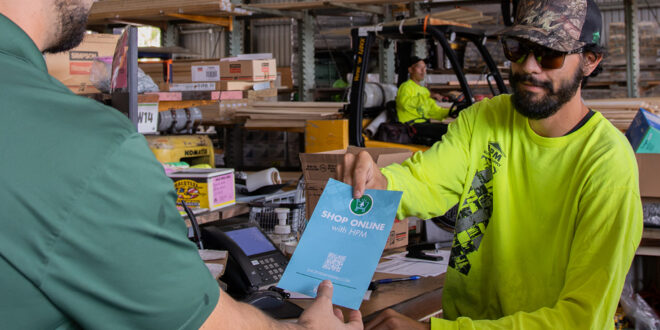
It’s been less than a year since HPM Building Supply launched its e-commerce site and in that short time, customer response has been overwhelmingly positive, especially from the company’s pro customers, who have embraced the platform to link their accounts, view their contractor pricing, pay bills, place orders and submit quote requests all in one place, says Sebastian Calaway, vice president of merchandising & marketing at HPM Building Supply.
“That kind of account integration has been a genuine gamechanger for that segment,” Calaway says. “For our everyday customers, the ability to check availability before making the drive, especially on an island where options are more limited, has been consistently appreciated.”
Calaway says one trend he’s noticed is a steady volume of purchases coming in during off hours—evenings and weekends—when the company’s stores are closed.
“It tells us customers value the convenience of shopping on their own schedule, not just ours,” he says.
HPM Building Supply has been providing high-quality materials, innovative technology, well-equipped facilities and superior customer service in Hawaii for over 100 years. The company carries more than 2,200 product lines at 19 locations throughout Hawaii and two in Washington.
Leadership at HPM Building Supply was seeing customers’ expectations shifting significantly, with customers wanting to be able to check product availability, compare pricing and place orders on their own schedule, not just during store hours. The COVID-19 pandemic was also a turning point for the company to make the shift to e-commerce, as customers expected to be able to confirm that the stores had on hand what they needed before making the trip, and they expected to be able to order on their own terms.
“Like many independent retailers, we watched customer shopping behavior shift in real time, and it became clear that convenience and online accessibility were no longer a nice-to-have. As a company rooted in community, we felt a responsibility to modernize and meet them where they are,” Calaway says. “E-commerce wasn’t just a business decision; it was about serving our customers better and honoring the trust they’ve placed in HPM for generations.”
HPM Building Supply leadership evaluated platforms and partners for several years, looking for the right fit and ended up partnering with ToolBx as the company’s primary vendor to build and power the online store, Calaway says. The e-commerce site is integrated directly with the company’s Epicor Bistrack ERP, a connection that is the backbone of the whole operation and keeps inventory data accurate and all teams working from the same information in real time. Inventory is synced between the ERP and online store through an API that refreshes every five minutes. The team at HPM Building Supply also built a secondary safeguard into the checkout process where if availability changes between when a customer adds something to their cart and when they complete their order, they’re notified immediately.
“It’s a layered approach, and for a business with multiple locations across the Hawaiian Islands that reliability matters,” Calaway says.
The company also leveraged its existing relationship with Orgill to take advantage of their product information management (PIM) system, which provided e-commerce ready product descriptions and images, a significant head start on catalog content that would have otherwise taken considerable time to build from scratch, Calaway says. Given HPM’s broad product offering, the initial online catalog was built to reflect a balance, leading with top-performing items while ensuring representation across all major product categories. The new e-commerce website provides customers the ability to browse and order from over 25,000 products and view detailed product information, specifications and real-time inventory.
“The goal was to give customers a meaningful cross-section of what we carry from Day 1, rather than a narrow slice that might not reflect the full HPM experience,” Calaway says. “Since launch, we’ve continued to build out the catalog, and at this point, the majority of our products are available on HPM Building Supply’s e-commerce platform.”
The site also includes a quote request feature to upload a file or simply write the products and quantities a customer is looking for and a member of the sales team follows up with an updated quote. Contractors can access their established volume-based pricing, organize orders by job site for better project management and easily reorder frequently used items through saved lists and order history. HPM’s e-commerce launched with in-store pickup, and the team is actively working toward adding local delivery, which is especially important for the operation’s contractor customer segment.
“For contractors on a jobsite, the ability to place an order and have it ready or delivered without losing time on the road is a meaningful value-add,” Calaway says. “That’s a natural and near-term next step for us.”
Existing teams at HPM Building Supply Stores—including order fulfillment, admin, pro sales and branch staff—handle the day-to-day operations for the e-commerce site. Additionally, two members of the merchandising and marketing team dedicate roughly half their time to the platform, focusing on catalog quality, user experience, training, process development and ongoing enhancements. Leadership trained employees to support e-commerce in segments by working through order fulfillment, admin, retail, pro sales and branch leadership separately, so each group understood their specific role. HPM also held a companywide session so every owner-employee could confidently answer basic questions from customers, neighbors and family members, Calaway says. This training is now also a part of new hire orientation training so any new hire coming onboard will be familiar with the company’s e-commerce process and platform. Step-by-step reference materials are stored on the HPM Building Supply intranet so employees can easily access the information anytime they need.
“Getting everyone prepared, not just the teams directly involved, made a real difference in the rollout of our launch,” Calaway says.
In the last few months, as the company has been evaluating the success of the new e-commerce platform, the teams have been looking at gross profit alongside a core set of customer metrics, including conversion rate, traffic, customer acquisition cost, average order value and retention.
“No single number tells the full story,” Calaway says. “What we’re really watching is whether our growth is healthy and sustainable: Are we acquiring the right customers, are they coming back and are we generating quality revenue? Those metrics in balance give us the clearest read.”
Reflecting on the process so far, Kā‘eo Awana, e-commerce channel and analysis manager, says he wishes he would have known how much bigger everything is than it looks from the outside. The catalog work—building out accurate, complete product content across thousands of SKUs—takes far longer than anticipated, and the technical integration with the ERP was more complex than it appeared on paper. And because e-commerce touches every corner of the business operationally, from fulfillment to finance to customer service, the ripple effects are felt throughout the organization.
“None of these are reasons not to do it, but going in with a clear-eyed sense of the true scope, rather than the projected scope, would have helped us plan and set expectations better,” Awana says.
For other retailers considering adding e-commerce, the team at HPM Building Supply says the biggest piece of advice, based on their experience through implementation, is to bring everyone to the table before you start building to help you establish clear requirements for your vendor partners and prevent costly surprises on both sides.
“The earlier you can get that alignment, the smoother everything downstream becomes,” Calaway says.
Despite some bumps along the way, the whole process has been worth it, which he realized the moment the first order was placed and picked up by a customer, Awana says.
“There’s something about seeing the full cycle complete—a customer browsing online, placing an order and walking out of the store with what they needed—that makes it real,” he says. “That said, we see e-commerce as a long-term investment, not a project with a finish line. We’ll continue to build and refine the platform because our customers deserve a better experience at every step, and that work is never really done.”
Catching New Customers
Bringing first-time customers into your business is a challenge every retailer contends with, regardless of how long an operation has been in a community. For a business to make 25% of its overall sales from single-purchase or first-time customers seems nearly impossible. But that’s the case for Family Hardware and its e-commerce program. Family Hardware in Cape Coral, Florida, opened in 1976 under a different name and was operated by several owners until current owner Jeremy Peterson bought the business in 2012.
The Gold Standard
3 Best Practices for E-Commerce Success
Once your e-commerce site is implemented and launched, it can’t be set-it-and-forget-it. Your e-commerce site should continually be evaluated and updated to stay on top of trends and assure you’re meeting customers’ online needs and expectations. Lean into these best practices to keep your e-commerce site fresh and effective.
- Create content for AI.
Whether you use it in your daily life or not, AI now plays a huge role in whether or your not your online e-commerce site will be seen by the right people. Product pages should include detailed information that both shoppers and AI systems can interpret, including thorough product features and specs. - Provide high-quality photos.
No longer will one product photo suffice. Customers want to see multiple photos of the product with different angles, including front, back, close-up and a lifestyle image. - Make navigation seamless.
Use clear category names that match how customers think and group categories logically. Keep the search bar always visible so customers can easily navigate from browsing to finding specific products.
He built a second store in a converted strip mall in Fort Myers in 2022. Peterson has made significant investments in the business to create the reputation of “family,” specializing in offering a customized experience for every customer who walks in the door. A customized experience is what online shoppers get as well. And it’s truly custom, as the POS, website and e-commerce platform Family Hardware uses is a completely tailor-made system that Peterson and a developer built entirely themselves. Peterson says he does not have a formal education in IT but grew up surrounded by technology and enjoys experimenting with innovation.
“When I was redesigning and updating the company website, the backend was similar to what we needed for the POS system,” Peterson says. “So as we were getting the store in Fort Myers ready to open, we were building out the website and POS system with the developer. We were able to get the new POS system ready for launch on Day 1 of the store opening.”
The system they were running e-commerce on before building the new platform didn’t meet Peterson’s expectations. The system couldn’t accommodate all of the SKUs Peterson wanted to sell, which includes over 60,000 items from their wholesaler and products sourced from other vendors.
“The previous platform didn’t manage traffic well, and if any little thing broke, it would crash,” he says. “The new system is so fast, and it performs well on mobile.”
The e-commerce platform now brings in about 25% of Family Hardware’s overall sales, and Peterson says most of those are small orders for niche products. Generally speaking, every e-commerce sale is the result of someone with a problem searching for a solution on Google or another search engine, Peterson says. His goal with the Family Hardware e-commerce site is to be near the top of their search results and earn that sale.
Peterson connects his store’s inventory to Google Products, which means when someone searches a part number or a product name, Family Hardware’s inventory shows up in the product results at the top of the page.
“The traffic coming to our website is purpose-driven,” he says. “People can’t find a product locally, so they search for it online, and our website comes up for them.”
Peterson says the most challenging part of driving sales online is determining what products to promote so they show up on Google Products. He spends a few hours a week putting Google Ads marketing dollars behind certain products to try to push them to the top of search results.
“You can’t single out one item that does well because as soon as you focus on something, the trend goes away,” he says. “The more you tweak the products you’re promoting, the worse it is. It’s very important to tweak and observe. In the beginning, I was very guilty about tweaking and not giving it time to work before fixing it again.”
Right now, Family Hardware only offers buy online, ship to home, and shoppers pay for shipping up to a certain dollar value. For the majority of items, they charge a $3.99 flat fee for shipping, and then, depending on the margin, orders over $75 earn free shipping. The system automatically calculates the shipping fee. For expedited shipping, shoppers have the option for UPS or FedEx, which they pay for regardless of the basket size.
“We are scaling back from the $3.99 shipping because in the ever-evolving ecom world, we found the profitability was in the larger orders and someone willing to spend $500 on an order was not going to worry about $3.99 shipping vs $11 or so,” Peterson says. “Our order volume went down, but sales volume is holding steady.”
All of the orders are shipped from one of Family Hardware’s wholesalers’ distribution centers, whichever is closest to the shopper. Peterson says this system works well for him, and it wouldn’t make sense from a labor perspective for him to bring someone in-house to manage orders and shipping from the store. Peterson also relies on his wholesaler for PIM, whether it’s images, product descriptions or specifications. He says when building an e-commerce website, PIM is the most important component. The second most important piece is the search function, which is closely tied to the system being able to suggest related products or products that are frequently purchased together. On the Family Hardware website, nearly every product shows variations of that item, for example, a PVC elbow that comes in a few different sizes. Each available size is shown as an option underneath the selected item. Peterson is in the process of launching an AI assistant called Howard, named after his grandfather, to complement the e-commerce site.
“I think chat-based e-commerce is going to be the future,” Peterson says. “We are programming it to always try and close the sale and upsell, though not too pushy. It also geo-locates the customer on the site or ask for their zip code, so it knows if we are talking shipping or in-store pickup. I think for people who are local, it will be great for closing special order items that we don’t have in stock.”