 Hardware Retailing The Industry's Source for Insights and Information



Navigating endless channels. Choosing the right audience. Tracking the analytics. Digital marketing can be a grind, and when marketing is just one of many hats a retailer wears, it can get pushed to the backburner or dropped altogether.
Rather than give up, getting back to the basics can provide clarity on where to start. Hardware Retailing spoke with retailers who have mastered some of the digital marketing basics—social media, Google Ads and SMS marketing—and share their insights on where to start and best practices for making these basics successful.
Getting Savvy With Social Media
Quickly moving from nice-to-have to must-have, social media provides an avenue to not only promote your business but also engage with customers in meaningful ways. The stats speak loudly to the importance of social media for reaching customers, especially in the home improvement channel. According to the Home Improvement Research
Institute’s Homeowner Social Media Influence on Home Improvement Shopping report, 58% of Gen Z and millennials have started a home improvement project specifically because of social media content and 69% rated home improvement retailers as trustworthy sources on social media. In the study, homeowners shared the top content they wanted to see on social media—expert advice on common mistakes, product comparisons or reviews, budget breakdowns and cost tips, detailed project tutorials and behind-the-scenes of real projects.
Because of these reasons, when sisters Lauren Melancon Guidry and Vanessa Melancon Pierce opened their hardware store, Melaco Sisters Hardware & Supply, in Cut Off, Louisiana, social media quickly became their go-to strategy for
marketing. The store opened in January 2019 and with Valentine’s Day soon after, Lauren turned to social media to promote products, using one of her 90-year-old employees in the video, which garnered a ton of attention and engagement.
“We realized then that we needed to keep utilizing social media, which is a lot easier said than done,” Lauren says. “Over the past seven years, I have had different people in a full-time position in advertising, and then I’ve also gone
through periods when I didn’t have help at all.”
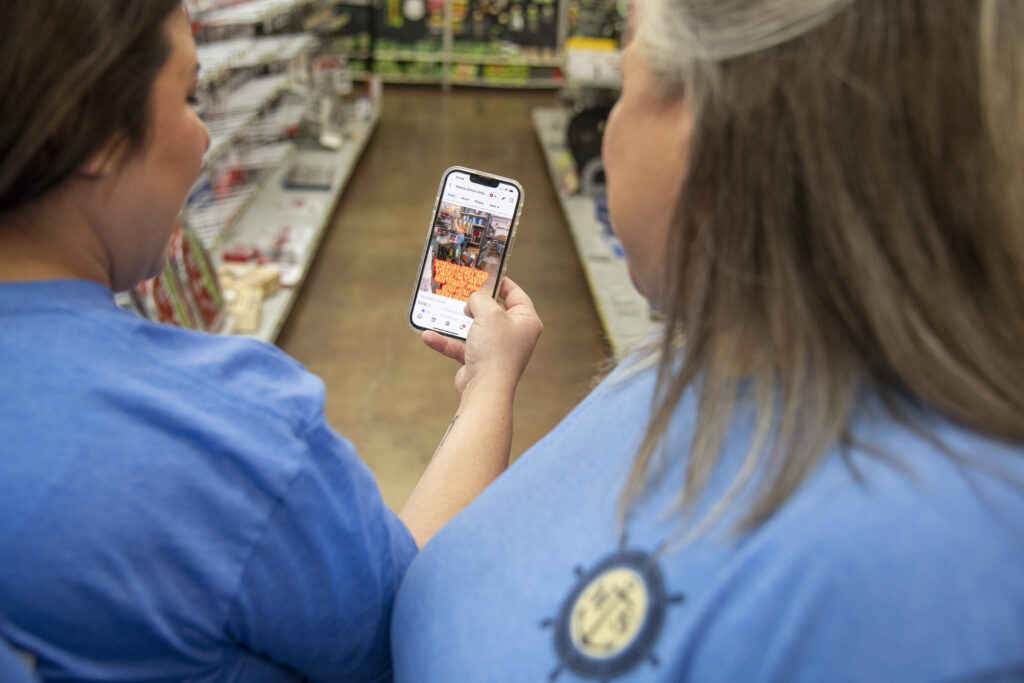 To take some of the marketing burden off her shoulders, Lauren turned to Do it Best’s consumer marketing program and then last year, brought on her other sister, Michelle Melancon, to take on the advertising lead role.
“She has taken all we have done up to this point in social media and elevated it,” Lauren says. Social media management is Michelle’s secondary role, behind her role at the paint counter.
“You don’t have to hire an advertising person, you just need a person inside your establishment who is willing to take the lead,” Michelle says.
Lauren treats advertising as a full department, giving it the same attention as other operational areas. Every Monday, Michelle and Lauren meet to discuss ideas for social media posts for the week and look ahead to any major events coming up that will need coverage. Vanessa will also provide ideas for posts.
“Michelle has creative authority, and I think as an owner that is very important if you want social media. You have to give some leeway to your staff within the guidelines you have set up,” Lauren says. “We have established a social media culture with rules. We don’t talk about politics or religion. We keep it politically correct and try to be funny and informative.”
Melaco Sisters engages with customers on Instagram, Facebook and TikTok, customizing content to meet the different demographics found on each, but also sharing the same content across all three when it makes sense.
“Each platform requires different posting frequencies and types of posts to be successful, so do your homework,” Lauren says. “Also, don’t be afraid to lean into the input from your employees. I utilized the generational gap in our employees to learn some new things.”
 Lauren and Michelle have tried a variety of posts. Those that have been the most engaging have been TikTok and Reels trends, product promotions done in fun and exciting ways, hardware memes and community focused content that supports other local businesses. Michelle has also started a fun collaboration with Ambridge Do it Best in Ambridge, Pennsylvania, to show cohesion outside of the local community.
“Especially living in a rural community, supporting the other businesses in our neighborhood is super important,” Michelle says.
Founded in 1928, Town Hardware & General Store in Black Mountain, North Carolina, has been offering a traditional in-store experience for nearly 100 years, but recently has focused on modernizing operations with an enhanced digital
presence on social media. Owners Peter and Beth Ballhaussen tasked Julie Williams, the wife of one of their employees, with handling social media management last spring.
“She is young and energetic, just had a baby and was looking for work that allowed her to stay home,” Beth says. “As Christians, we believe that the Lord really tells us things, and we’ve learned to listen. We felt strongly that Julie might be very good at social media. We were right. She has been excellent and has really taken our social media to a new level.”
Once a week, Peter and Beth meet with Julie to talk through the social media content calendar for the upcoming week. Julie does research on upcoming National Days—like National Cat Day, National Reading Day, National Coffee Day—and finds ways to tie those into products the store sells. Other types of posts that garner the most engagement include home improvement tips, community-related information and anything featuring store employees.
“I try to look at every post, every day, and I see customers especially engaging with those posts where we include employees,” Beth says. “It gives our customers a touchpoint for those who will help them when they come into our store.”
Peter and Beth have also recently added the “Buy Now” button to their Facebook page. They haven’t been tracking any analytics yet, but anecdotally have seen an increase in online orders since adding it.
“Social media and online is how customers find out about things nowadays, so for us to stay relevant, we need
to be there too,” Beth says.
At Country Ace Hardware in Granby, Colorado, social media provides the hyperlocal connection that complements the national advertising reach the store receives from its co-op. President Amy Kaplanis says the store works with a local marketing consultant to manage their social media pages, which include Facebook and Instagram. The consultant helps build a social media content calendar than connects with the community and includes celebrating employees, promoting store and local events and promoting other local businesses.
“That hyper-local marketing is how we differentiate ourselves from other local stores and make people interested in coming in and checking us out when they are in town,” Kaplanis says. “We have developed engagement with the community, which helps us keep top of mind within the community.”
Texting Your Message Out
Launched in November 2024 at Hartville Hardware, SMS marketing, also known as text message marketing, has already proven to be an effective marketing tool. Hartville Hardware e-commerce copywriter Beverly Prendergast was the brainchild behind the strategy and chose to launch in November with a few event and sale-centered messages.
 “Christmas at Hartville Hardware is a big event, so it was an ideal time to bring in subscribers looking for family-friendly events and Christmas savings,” Prendergast says. “While email is an effective marketing strategy, it’s less common for people to check their emails consistently. SMS is a secure method of ensuring our message reaches the customer.”
Starting in January 2025, Prendergast expanded SMS marketing, adding national messaging to the local messages going out every week. She develops the topics and content for all SMS messages, sends them out for review and then schedules the dates and times they are sent.
“Since we are still new to SMS, we only target our local and national audiences,” Prendergast says. “As we continue
to implement SMS, we will segment our audiences more to target specific hobbyists, such as DIYers and tool enthusiasts.”
Currently, the operation sends one national and one local message each week. Some weeks, the number of messages
increase because of in-store events or national promotions. This cadence has kept Hartville Hardware’s audience
engaged, without overwhelming their inboxes. Many of the operation’s local messages focus on events and in-store sales, like its GrillFest event and Tool Sale & Expo, to draw traffic to the stores. Local messages may also feature departments relevant to a specific season. Hartville
Hardware’s Grill Zone and Greenhouse are featured in the spring and summer, while the Christmas Shop is featured in the fall and winter.
National messages cover a wide range of topics, including new products, current sales, holidays and topics relevant to the time of year. Back-to-school messages crop up in August, while a message featuring outdoor toys can appear in June or July.
“As newcomers to SMS marketing, we are encouraged by the steady growth of our subscriber base and proud
of maintaining an exceptionally low unsubscribe rate,” Prendergast says. “Even in our first year, SMS has proven to
be a meaningful revenue driver, reinforcing its value as part of our broader marketing strategy.”
Currently, Prendergast works with a standard SMS platform that offers only basic functionality and minimal analytics. Moving into 2026, the company will upgrade to Klaviyo—a system with deeper insight and expanded capabilities.
“With a solid baseline established, our move to Klaviyo will allow us to mature our SMS program—broadening functionality, deepening insights and supporting long-term growth objectives,” Prendergast says. “Looking ahead to 2026, this transition positions us to maximize the overall impact of SMS within our customer engagement plan.”
Google Ads
Persuaded by a fellow marketing colleague that Google would be the future of marketing, David Stine, vice president of marketing and merchandising at Stine Home+Yard, added Google Ads to the operation’s digital marketing strategies.
“They made a statement to us that the companies that are going to succeed in the future will be the only ones that are on Google,” Stine says. “The direct comment as I remembered was, ‘If you’re not doing this in five years, you’ll be out of business.’ And so that was kind of an existential comment to me.”
Google Ads allow businesses to create ads that appear across Google’s properties, including Google search, YouTube and partner websites. Google Ads operate on a pay-per-click (PPC) system with advertisers bidding on keywords to have their ads displayed to users who are actively searching for those terms.
When it comes to starting with Google Ads, Stine says it’s crucial to have a high-caliber website. He then recommends
joining Google Merchant Center in order to fully engage with all Google Ads have to offer. With Google Merchant Center, a business can upload its product data to Google and make it available to Google Shopping or other Google services.
Many businesses utilize a marketing agency to help them navigate Google Ads, but Stine works directly with a rep from Google. Stine takes part in the Google Performance Max program, which takes products the company wants to promote and determines the spend that company should do based on its goals for Google Ads.
“When you’re spending money in advertising your brand name and building awareness, you really don’t know who you’re advertising to; it’s just a shotgun approach. You’re promoting your name and that you’re in the home improvement business with this product or that product, but you don’t really know whether those people have any interest in purchasing,” Stine says. “We are trying to reach the most engaged customers, those at the bottom of the marketing funnel.”
For example, those customers who know they want a specific grill or brand name tool are searching for it on Google, usually with the phrase “near me,” and ads from nearby stores that carry that product will show up in the search.
“Typically, it will be big boxes that show up, but it won’t be a lot of independents because they don’t have their catalog with Google Merchant Center,” Stine says. “But since we’ve joined Google Ads and Google Merchant Center, we’re now included in those search results, and we actually compete very well in our markets now.”
Increasing those impressions is one of Stine’s goals with Google Ads; another big goal is increasing visits to the operation’s website. By utilizing Google Ads, event counts—specific user actions beyond page views, such as button
clicks, video plays, form submissions and purchases—on Stinehome.com are up 40%. Page views are up 36.6%, with
32,200 daily page views and user engagements are up 36 points or 37%.
“While this hasn’t translated to that kind of increase in sales, it has elevated our presence online, which we feel
will lead to them stepping into our stores,” Stine says. “We’ve made some inroads, and we’re competing with companies that have been doing this for years, but now we’re in that space.”
Anecdotally, Stine ran a seasonal grilling marketing campaign with the slogan “Choose the Better Bucket and Get
the Better Service.” The campaign included a comparison of Lowe’s blue bucket, The Home Depot’s orange bucket and
Stine’s green bucket.
“The buckets are just metaphors for the three companies. The reason we like the campaign is because it puts us in
the same conversation with those guys, which is a win already, because that’s where America shops,” Stine says.
“The campaign actually had a 38% lift in sales in just the grilling area that we think is attributed to the marketing
we’re doing.”
Overseeing everything from social media to display advertising to retargeting campaigns, Knudson Lumber Co.
marketing and advertising director Cheryl Roberts also leads the company’s Google Ad efforts. When Roberts joined the Knudson Lumber team in 2016, one of her first priorities was to establish a Google Business profile for the operation, which is located in Ellensburg, Washington, and launch the store’s first Google Ads campaign.
Roberts manages Google Ads directly, with support from the Google Ads team. She receives monthly performance reports and schedules quarterly calls with a Google Ads associate to review what’s working, fine-tune campaigns and adjust the budget to account for seasonal changes, such as busier building months versus slower periods.
“While there are agencies that will take this on for a fee, my expertise makes in-house management both easier and more cost-effective,” Roberts says. “Instead of spending money on outside management, those dollars go straight into the campaigns themselves. We also use Google Analytics, which is integrated into our website, to track page performance and conversions. Analytics provides a deeper dive into user behavior, while Ads gives us the flexibility to tailor campaigns in real time.”
Recently, Roberts has started utilizing Google Ads’ Performance Max Campaigns, which are designed to meet specific business goals. They can be more expensive, but provide excellent value by automatically optimizing ads to match customer searches and behaviors. Combined with quarterly reviews and seasonal budget shifts, Performance Max has allowed Knudson Lumber to maximize impact and efficiency throughout the year, Roberts says.
For retailers wanting to bring Google Ads to their operation, Roberts recommends taking a “crawl, walk,
run” approach by first setting up a Google Smart Campaign and then scheduling a call with a Google Ads representative. These reps ensure advertisers are making the most of Google’s recommendations, show
how to monitor campaigns and help tailor campaigns to fit both geographic reach and specific business goals.
“A large budget isn’t necessary—independent retailers can’t always compete with the spending power of big-box stores, but they do have an advantage in knowing their local markets,” Roberts says. “In today’s marketplace, being present on Google is essential. To compete, you need to be playing in the same sandbox as everyone else.”
Strengthen Your Digital Presence
- Companies with strong omnichannel engagement strategies retain an average of 89% of their customers.
- Companies with weaker omnichannel engagement strategies only retain about 33% of their customers.
Connect + Engage: Best Social Media Practices
Answer the comments. Melaco Sisters Hardware & Supply’s Michelle Melancon monitors likes and comments and responds as often as she can to engage with customers and improve the algorithms needed to boost the reach of each post.
1 | Answer the comments. Melaco Sisters Hardware & Supply’s Michelle Melancon monitors likes and comments and responds as often as she can to engage with customers and improve the algorithms needed to boost the reach of each post.
2 | Incentivize employees to participate. To encourage employees of Melaco Sisters to participate in social media
posts, the sisters offered employees a $5 credit on their store account. Michelle says they now even have customers come into the store just to meet the employees they see in the social media videos.
3 | Utilize technology. Michelle uses the tools provided through Meta to schedule and manage social media posts on Facebook and Instagram, and TikTok for Business to schedule those posts. Both programs also provide analytics to help you see if what you’re doing is actually engaging and successful.
Work Smarter, Not Harder
3 Digital Marketing Strategies for Small Businesses
- Partner with vendors. Work with your company’s wholesalers and vendors to leverage the marketing
and digital programs they offer, such as e-commerce capabilities, product information management
(PIM), digital assets and marketing campaigns. - Send your weekly or biweekly sales circular digitally. Many retailers still find success with a printed mailing circular, but can expand their reach by sending those circulars through email and posting on social media or your website.
- Leave it to the experts. For digital marketing tasks like SEO and Google Ads, sometimes it’s better to rely on third-party vendors and service providers, as they can become complicated and time-consuming.
While it certainly doesn’t hurt, having a full marketing team is not necessary to build a successful digital presence. Here are three ways to get the most out of your marketing staff and budget, no matter how small.
Pushing the Bar
Latest Updates From Google Ads
Celebrating its 25th anniversary in October, Google Ads has forever changed the digital marketing landscape. In the last quarter century, Google Ads has changed dramatically and continues to evolve rapidly. Here are the latest updates from Google Ads and the features it offers to bring your business to your audience.
AI Max for Search Campaigns: This tool will expand upon existing keywords using broad match and keyword-less technology to find more relevant and high-performing search queries and help advertisers show up in new, relevant searches.
Demand Gen Channel Controls: Allows advertisers to choose where their ads appear, including YouTube, Discover, Gmail and YouTube Shorts, with the ability to add Google Display inventory.
Unified Reporting: Web and app insights are integrated into a single workflow, with unified conversion setup and combined overview cards on the Google Ads homepage.