 Hardware Retailing The Industry's Source for Insights and Information


In life, comparison is the thief of joy, but when it comes to business, comparison is a key component to evaluate progress and gauge success. In the independent home improvement industry, running a gap analysis is one of those tasks high-performing retailers tackle on a regular basis and a crucial task to see blind spots and points of improvement.
To aid retailers in the process of conducting gap analyses, the North American Hardware and Paint Association (NHPA) annually conducts the Cost of Doing Business Study, which provides detailed financial information from hardware stores, home centers, lumber and building materials (LBM) outlets and paint and decorating outlets in the U.S. In each segment, data is presented for the typical store, for high-profit stores, for single-unit and multiple-unit companies and for sales volume categories. Additionally, there is a five-year historical trend for typical stores in each segment, including paint stores.
For over 100 years, independent home improvement retailers have used the Cost of Doing Business Study to benchmark their business against industry averages, identify ways to reduce costs and increase profits, uncover hidden growth opportunities and plan for long-term financial success.
“The Cost of Doing Business Study allows retailers to see direct results between their income statement and balance sheet versus the rest of the industry,” says Dave Gowan, NHPA chief financial officer. “They can use the ratios included in the study to guide a plan for revenue growth and to help cut expenses.”
Analysis in Action
Started as an Army Navy Surplus Store by John and Nellie Samore, Vermont Outlet True Value Hardware opened in Los Angeles in 1949.  A few years later it became an outlet store, selling paint, plumbing, tools, ceramics, clothing, hardware and other merchandise at a significant discount. John and Nellie’s three sons—John, Ron and Jim—have been active in the business at various times throughout the history of the Vermont Outlet. Today, Ron is the president and chief operating officer, Jim has retired but still provides guidance and John assists in a consulting role, increasing the efficiency, productivity and modernization using his over 50 years of experience as a CPA, including 21 years as a partner with Arthur Andersen.
“Our growth over the years can be attributed to the fact that our customers are not only treated with respect, but our product knowledge helps them quickly solve their problems,” John says. “Our prices are reasonable, and our store size makes customers feel comfortable and makes it easy for them to find what they need.”
For John, taking part in gap analyses using the Cost of Doing Business Study has improved the operation’s bottom line by focusing on the matrices and indices that enhance pre-income tax profits. Samore compares his operation’s data with the high-performing retailers’ numbers presented in the study. For another angle, he also looks at The Home Depot’s numbers.
“Even though it is billions of dollars bigger, The Home Depot has two locations that are three miles away in each direction of our store, so it’s important to look at those numbers as well to best compete in our market,” he says. “Also, because it is a public company, much information is available on The Home Depot from the Securities and Exchange Commission, such as annual and quarterly reports, to help me.”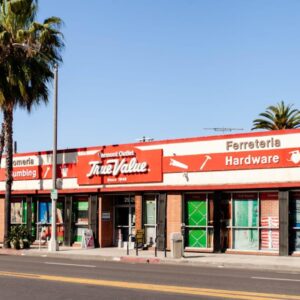
John conducts a gap analysis four times a year, and along with the Cost of Doing Business Study and Home Depot annual reports, he utilizes the True Value Work Bench.
When looking at the data from these different sources, John hones in on sales, cost of goods sold, gross profit, sales per square foot, customer count and sales per customer.
As a result of the most recent gap analysis, John has taken steps to improve declining sales, one of the operation’s major issues. The operation’s annual sales goal is to increase sales by 10% and have a gross profit margin of 48%. Although sales are even with 2024, Vermont Outlet’s average gross profit is down 7% because sales to professionals have decreased.
“Pro counts are down. So is DIY, but the pro hurts more. Government is a larger percentage of sales this year, but the margin is much lower,” John says. “If we could sell $10,000,000 to the government at 5% gross profit margin, we would exceed our present operating gross profit budget by $300,000.”
Being in Los Angeles, John says they can’t rely solely on DIY.
“We would be out of business if we depended on DIY. The same holds true for Home Depot, Lowe’s and others,” John says. “We all need the pros, which is why both Home Depot and Lowe’s are making major pro-related acquisitions.”
 Getting front-line employees on board with new expectations and strategies needed to close gaps starts with leadership providing transparency.
“Employees attend monthly meetings and receive full financial transparency, so they each feel they own a part of the Vermont Outlet,” John says. “Our various financial incentives keep them in the game from the top to the bottom as a team and individually. We empower employees to do the work that needs to be done to grow.”